

Conversion in Acts, Part 5, Cornelius’ P.O.V.
Introduction
We come to a very significant event in all of history; when Gentiles are permitted to be saved from their sins and added to the body of Christ (Acts 2:41,47; Col. 1:18; Eph. 1:22-23). It’s been about ten years since the Holy Spirit descended on the apostles on Pentecost and, even though Peter mentioned them (the Gentiles, Acts 2:39), they were still going to the Jews only.
Again, due to the amount of information provided in Acts 10 and 11, I’ll be breaking up this discussion in two separate articles. First, we’ll look at it from Cornelius’ point of view then, the one to follow, will be from Peter’s point of view. Both are worthy of their own articles and you’ll see why.
Before you continue this article, I encourage you to read all of chapter 10 or, at least, verses 1-8 and 24-48. We’ll look at the rest of chapter 10 in the next article.
Meet Cornelius
In the verses 1 and 2 of Acts 10, we are introduced to a centurion; an officer of the Roman army who oversaw 100 men (a century). Look closely at verse 2, a devout man and one who feared God with all his household, who gave alms generously to the people, and prayed to God always.
Although the Jews were God’s chosen people, it doesn’t mean that the rest of the planet went unnoticed. Keep in mind that while the Jews had The Law according to Moses; the 10 commandments, etc., there was law prior to that according to Abraham, Isaac, and Jacob.
Cornelius essentially did everything the Jews did as far as worship, prayers, and the giving of alms. But they did it separately, since they were of the uncircumcised.
Cornelius’ Vision
The next few verses, gives an insight of what was to transpire, About the ninth hour of the day he saw clearly in a vision an angel of God coming in and saying to him, “Cornelius!” And when he observed him, he was afraid, and said, “What is it, lord?” So he said to him, “Your prayers and your alms have come up for a memorial before God. Now send men to Joppa and send for Simon whose surname is Peter. He is lodging with Simon, a tanner, whose house is by the sea. He will tell you what you must do.” (Acts 10:3-6)
Once again, we see an opportunity of the so-called “direct operation of the Holy Spirit” being given the chance to exist. If it was a true doctrine, the angel would have never told Cornelius to send for Peter. Instead, he would have simply told him that he and all of his household were already saved as they were believers. Instead, the angel told him to send for Peter who, in turn, would tell Cornelius what he must do!
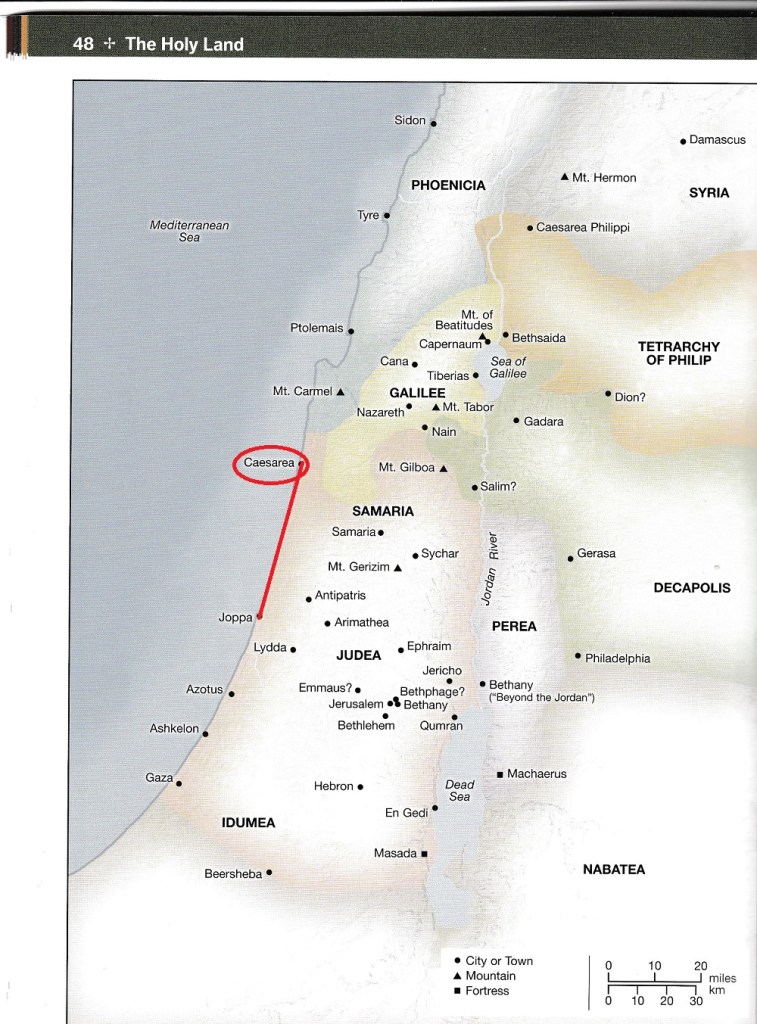
In the next two verses he calls for two of his servants and a devout soldier to go to Joppa and tells them what had just transpired. It’s about 32 miles so they will set out the next morning. Most people would travel in pairs or groups. No one would travel alone if they could help it. Sending a soldier along was, most likely, for protection but perhaps as further assurance to Peter that the reason they were sent would be worth his time.
Gathering the Household
Jumping down to verse 24, while Cornelius was waiting for Peter’s arrival, he spent that time contacting all of his relatives and close friends to let them know that someone was coming to share the message of salvation. There’s no exact number given of how many people were there but it shows that Cornelius was concerned for the souls of his family and friends. He wasn’t planning on hoarding the apostle’s time all to himself, he wanted to share Peter’s message with as many people as possible.
Peter Meets Cornelius
Upon Peter’s arrival, Cornelius falls to the ground to worship him. He didn’t perceive the apostle as deity but, rather, one of great importance to serve as a representative of God; His spokesman or mouthpiece. Peter immediately corrected him by saying, “Stand up; I myself am also a man.” (Acts 10:26)
Peter was simply showing him that there was nothing special about him; that he lived his life just like any other human being. He refused worship which is contrary to what the Catholic religion claims; that Peter was the first pope and all must worship each pope as the vicar of Christ.
As Peter and his companions entered within, they were greeted by a group who were there to hear the gospel (vs. 27). Before they progressed, further, Peter tells Cornelius, “You know how unlawful it is for a Jewish man to keep company with or go to one of another nation. But God has shown me that I should not call any man common or unclean. Therefore I came without objection as soon as I was sent for. I ask, then, for what reason have you sent for me?” (Acts 10:28-29) The word ‘unlawful’ isn’t very accurate as he hasn’t broken any law but rather a Jewish custom. A word suggested in a commentary is, ‘taboo’. This fits the context better.
Peter wanted to hear from Cornelius himself, why he was sent and why he is standing in the midst of a group of Gentiles. Verses 30-33, Cornelius relays the event which had already been told him by his two servants and the soldier when they went to get Peter. The apostle wanted verification by the man himself to make sure that this wasn’t some ruse or stunt to see if a Jew would actually enter the house of a Gentile.
No Partiality
After Cornelius tells his story, Then Peter opened his mouth and said: “In truth I perceive that God shows no partiality. “But in every nation whoever fears Him and works righteousness is accepted by Him. (Acts 10:34-35)
Whereas salvation was to the Jews only; under the Old Law, under the Law of Christ it is given to everyone, regardless of gender, ethnic background, social status, etc. Peter later reiterates this in 1 Peter 1:17 and the apostle Paul confirms this in Rom. 2:11; Gal. 2:6; Eph. 6:9; Col. 3:25.
Confirmation of the Gentiles Acceptance
Jumping down to verse 44, something miraculous occurs while Peter was preaching to them. While Peter was still speaking these words, the Holy Spirit fell upon all those who heard the word. And those of the circumcision who believed were astonished, as many as came with Peter, because the gift of the Holy Spirit had been poured out on the Gentiles also. For they heard them speak with tongues and magnify God… (Acts 10:44-46)
If the vision Peter received wasn’t convincing enough, this definitely solidified in his mind that the Gentiles were accepted by God. Peter later remarked that he had never seen such an event since the beginning, referring to the day of Pentecost (Acts 11:15-17).
This is the reason I pointed out, at the start of the article, that Cornelius’ conversion took place 10 years after the day of Pentecost. No such event had occurred since that time and none to this day (1 Cor. 13:8-10).
A question could then be asked, “Did Cornelius and his family keep the gifts that were given them?” The answer is not revealed in scripture. As for my opinion, I believe it was simply temporary to show to the Jews that the Gentiles were indeed accepted by God. They were then baptized (vs. 47-48) and, by doing this, it showed that just because the Holy Spirit descended on them, they were still in their sins.
Conclusion
The conclusion of Peter’s defense before the Jews in Jerusalem sums up this article nicely, “If therefore God gave them the same gift as He gave us when we believed on the Lord Jesus Christ, who was I that I could withstand God?” When they heard these things, they became silent; and they glorified God, saying, “Then God has also granted to the Gentiles repentance to life.” (Acts 11:17-18)

 The Christian Caravan
Leave a comment