

Introduction
Following on the heels of the previous article, we have this acronym to encourage Christians and their prospects. The letters above stand for Teach, Baptize, and Teach Some More. In the article below we’ll look at each part of this acronym and explain its importance.
Teach

In Rom. 10:14-17 the apostle Paul writes, How then shall they call on Him in whom they have not believed? And how shall they believe in Him of whom they have not heard? And how shall they hear without a preacher? And how shall they preach unless they are sent? As it is written: “How beautiful are the feet of those who preach the gospel of peace, Who bring glad tidings of good things!” But they have not all obeyed the gospel. For Isaiah says, “Lord, who has believed our report?” So then faith comes by hearing, and hearing by the word of God.
The primary function of a seasoned Christian is to go out and teach. Jesus said, “Go therefore and make disciples of all the nations…” (Matthew 28:19) All too often, you hear people state that one morning they woke up and believed that Jesus is the Christ and that he died on the cross for their sins. To them, that makes them a Christian. Although belief is necessary, most couldn’t answer the question of why Jesus was sent to Earth in the first place and why did he die on the cross?
This is where teaching comes in. Prior to his statement about going and making disciples, Jesus said, “All authority has been given to Me in heaven and on earth.” (Matthew 28:18) If Jesus has all authority (and he does) then his words are valid and must be obeyed. This is why so many have an issue with his command to be baptized. We’ll look at that in just a moment.
Once Jesus’ authority is understood, then you can explain why God sent him to Earth, he became an example for us (1 Pet. 2:21), then ultimately went to the cross and died, willingly, (1 Jn. 3:16) for the sins of all mankind (Rom. 5:8). Thus, salvation is available to all who obey The Father (Mt. 7:21; Titus 2:11; 2 Pet. 3:9).
Baptize
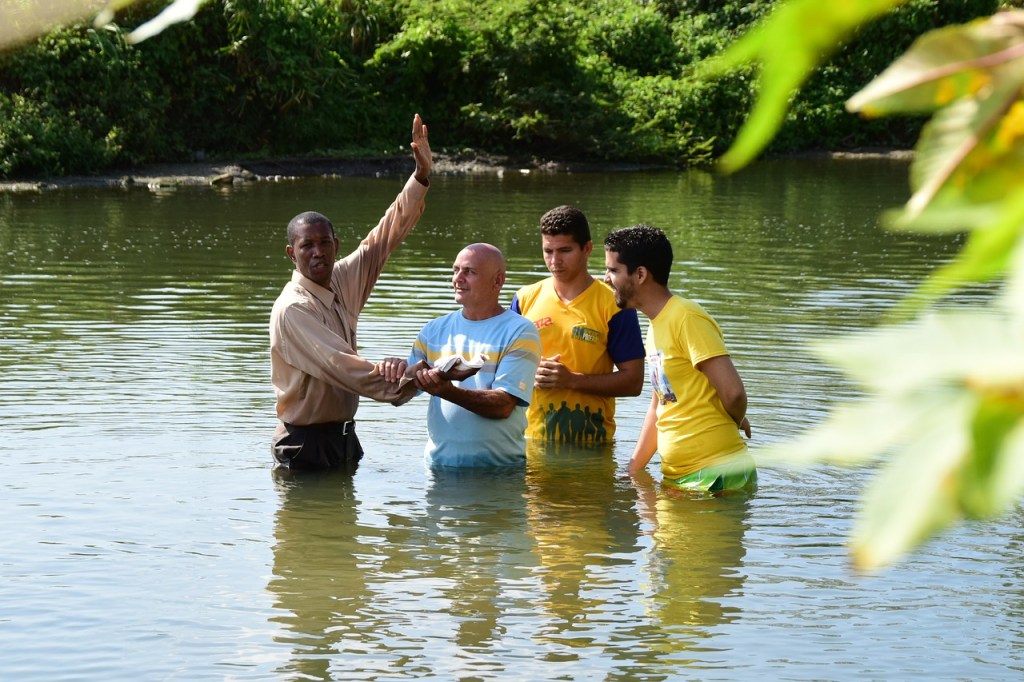
As we stated, Jesus has all authority which then brings us to his command, after his resurrection, but before his ascension, “He who believes and is baptized will be saved; but he who does not believe will be condemned.” (Mark 16:16) The apostle Peter confirms this on the day of Pentecost when he said, “Repent, and let every one of you be baptized in the name of Jesus Christ for the remission of sins; and you shall receive the gift of the Holy Spirit.” (Acts 2:38)
The naysayers of baptism love to point out the so-called fallacy of Jesus’ statement in pointing out that Jesus doesn’t mention ‘baptism’ in the second half of his statement referring to those who will be condemned. They believe the second half should read, ‘He who does not believe and is not baptized will be condemned.’ If someone doesn’t believe, why would the subject of baptism even be entertained?
Suppose an atheist came into the church building and declared that he didn’t believe Jesus is the Christ but wanted to be baptized anyway. How would you respond? For what reason would an atheist, or anyone who doesn’t believe, be baptized? What words would you even use?
We know, from scripture, that Jesus said, “…baptizing them in the name of the Father and of the Son and of the Holy Spirit” (Matthew 28:19b) Along that line then, in whose name (or by whose authority) would an atheist be baptized if they don’t believe? To ask is to answer.
Teach Some More

Once a person has been baptized, then you need to continue to teach them. A lot of people believe that once you are baptized then you are done. You can sit back, relax, and wait for heaven. You need to keep in mind that baptism is a rebirth.
When a child is born, you help them to grow stronger through nouishment, and you teach them as they become older. You don’t give birth and then place them in a corner and say, I’m done!
This is why Peter wrote, but grow in the grace and knowledge of our Lord and Savior Jesus Christ. To Him be the glory both now and forever. Amen. (2 Peter 3:18) Baptism is just the beginning! There is so much more to learn. Peter gives a list of things to work on, But also for this very reason, giving all diligence, add to your faith virtue, to virtue knowledge, to knowledge self-control, to self-control perseverance, to perseverance godliness, to godliness brotherly kindness, and to brotherly kindness love. For if these things are yours and abound, you will be neither barren nor unfruitful in the knowledge of our Lord Jesus Christ. (2 Peter 1:5-8)
Jesus also said, “…Be faithful until death, and I will give you the crown of life.” (Revelation 2:10) Sitting back and doing nothing doesn’t help you to continue to be faithful. You need the help of the brethren for accountability (Gal. 6:1-2)
Study the book of Acts and learn what the first century disciples did. Here’s one example, And they continued steadfastly in the apostles’ doctrine and fellowship, in the breaking of bread, and in prayers. (Acts 2:42) These people were eager to learn. None of them just sat back and waited. They wanted to know more so they could, in turn, teach others.
Conclusion
As you study with a prospect and the decision to become baptized is made, make sure the student knows that once they are baptized, you will continue to study with them. Don’t allow them to think that studying is finished once they conclude to be baptized. There is so much more to learn and encouragement is necessary to show them they are only just beginning.
 The Christian Caravan
Leave a comment