
Introduction
We’re all familiar with a courtroom scene when a witness comes forth, raises their right hand, and swears to tell the truth, the whole truth, and nothing but the truth…
Now if one lies while under oath it is called perjury. This is a modern term for a false witness who speaks lie. This is another thing that God hates.

Definition
Perjury—The act or crime of willfully making a false oath, when lawfully administered; or a crime committed when a lawful oath is administered in some judicial proceeding, to a person who swears willfully, absolutely and falsely in a matter material to the issue. (1828 Webster’s Dictionary)
Bible Example in O.T.
In 1 Kings 13, a story unfolds about a young prophet who traveled to Bethel to speak out against King Jeroboam at his altar of incense. When the king tried to have him arrested, his hand withered and the altar was split in two (vs. 4-5).
The king, changing gears, invited the prophet back to his place for food and a time of refreshing (vs. 7). But the young prophet refused stating, “If you were to give me half your house, I would not go in with you; nor would I eat bread nor drink water in this place. For so it was commanded me by the word of the LORD, saying, ‘You shall not eat bread, nor drink water, nor return by the same way you came.’” (vs. 8-9)
At this point an older prophet comes upon the scene and encounters the young prophet who states to the elder that he cannot return with him (vs. 16-17). Here was the old prophet’s response, “I too am a prophet as you are, and an angel spoke to me by the word of the LORD, saying, ‘Bring him back with you to your house, that he may eat bread and drink water.’” (He was lying to him.) (1 Kings 13:18) Notice the statement in parenthesis, the old prophet was lying; a false witness utilizing what was said to the young prophet and twisting it for his personal gain.
Unfortunately, the young prophet listened to the old prophet (perhaps out of respect) and he lost his life for disobeying the word of the Lord (vs. 21-24). Listening to a false witness has major consequences.
Bible Example in N.T.
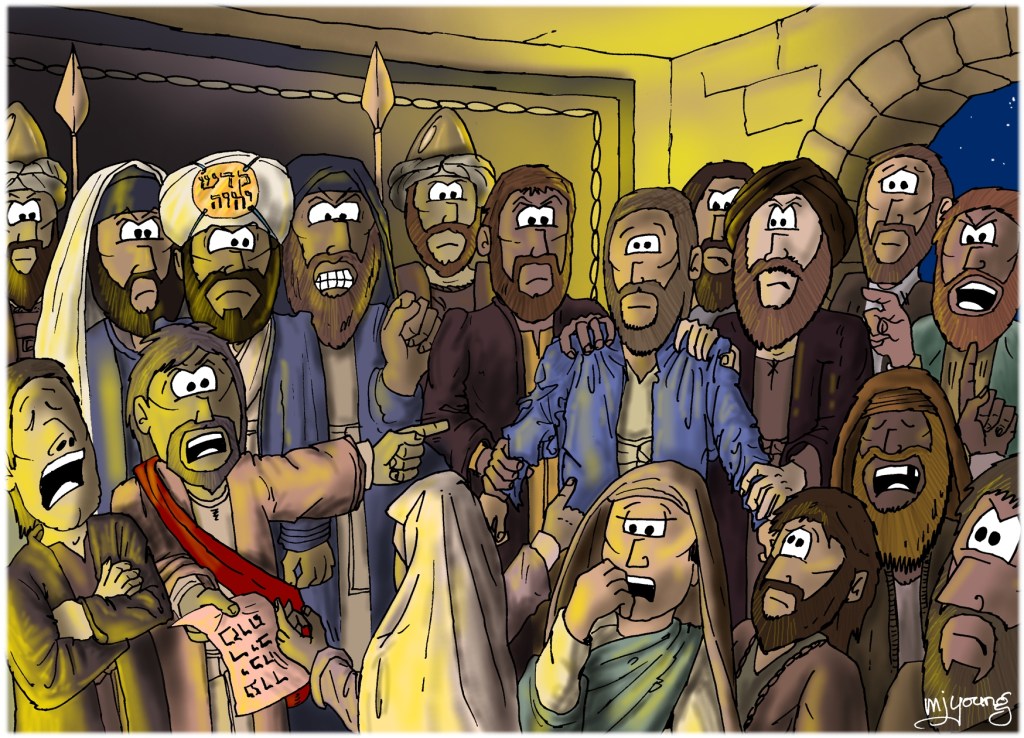
Turning to the New Testament, the idea of false witnesses instantly brings to mind the trial that Jesus suffered through. In Matthew 26, we see this scene, Now the chief priests, the elders, and all the council sought false testimony against Jesus to put Him to death, but found none. Even though many false witnesses came forward, they found none. But at last two false witnesses came forward and said, “This fellow said, ‘I am able to destroy the temple of God and to build it in three days.’” And the high priest arose and said to Him, “Do You answer nothing? What is it these men testify against You?” (Matthew 26:59-62)
In Mark’s account, a little more information is gained, For many bore false witness against Him, but their testimonies did not agree. Then some rose up and bore false witness against Him, saying, “We heard Him say, ‘I will destroy this temple made with hands, and within three days I will build another made without hands.’” (Mark 14:56-58)
Even though they were looking for false witnesses, they couldn’t get them to collaborate on the same story. They made a bad situation worse.
Encouragement for the Christian
As seen in the previous article on lying, Jesus said, “But let your ‘Yes’ be ‘Yes,’ and your ‘No,’ ‘No.’ For whatever is more than these is from the evil one.” (Matthew 5:37)
The apostle James wrote, But above all, my brethren, do not swear, either by heaven or by earth or with any other oath. But let your “Yes,” be “Yes,” and your “No,” “No,” lest you fall into judgment. (James 5:12) James, here, is echoing the same sentiment as Jesus in His sermon on the mount. But he also adds not to swear on anything also. The Jews, in his time, had the habit of making both binding and non-binding oaths. The latter is what James is referring to.
In modern terms, when someone makes a statement, then adds the phrase, “I’ll swear on a stack of bibles” or “I swear on my father’s grave”. This addition to the previous statement shows that you are not of a trustworthy nature to simply reply, “Yes” or “No”. You believe that by adding the oath at the end confirms it when, in actuality, makes people doubt you all the more.
Conclusion
The bottom line, here, is if you aren’t 100% sure of what you’ve seen or heard, it’s best that you do not involve yourself in the matter. Going by what you think you’ve seen and heard will damage your credibility as a Christian and will become a blemish on the local congregation. As James wrote, If anyone among you thinks he is religious, and does not bridle his tongue but deceives his own heart, this one’s religion is useless. (James 1:26)
**Announcement**
Beginning May 6th, Monday’s articles will move to Tuesdays. I will be starting a new concept called “Monday Memes” where I’ll look at some religious memes and discuss their application.
 The Christian Caravan
Leave a comment