
Getting to Know God’s Word, Part 9
Introduction
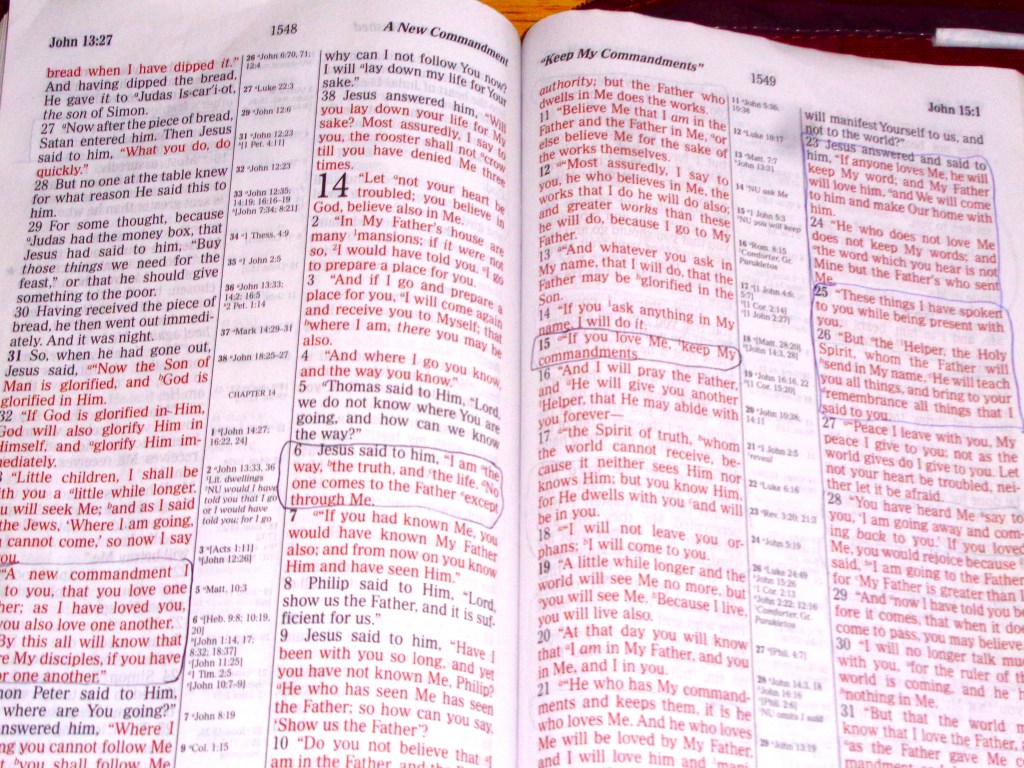
Many people own a copy of the bible in which it is stated that the Words of Christ are printed in red. Before I go any further, I am not taking sides in this idea. I believe that this is an excellent tool for the Christian who is just starting out as a bible student.
I have copies of that style of bible, as well as those who don’t have His words in red. If you’re a seasoned student, you don’t need those red words to understand who is speaking when reading the context of the chapter.
However, there are those who believe that the words in red are the only necessary words to read in the New Testament because Jesus, Himself, said it. We’ll explore this idea in the article below.
Origin of this Style of Bible
The “Words of Christ in Red” bibles have only been around since the early 20th Century. The creator, Louis Klopsch, came up with the idea when he read, Likewise He also took the cup after supper, saying, “This cup is the new covenant in My blood, which is shed for you.” (Luke 22:20) Given that blood is red, this is the perfect reason to color Jesus’ words in red. For more information, read the article by clicking on this link.
As far as I’m concerned, it doesn’t matter what color you use, the text still reads exactly the same. And it doesn’t come as any surprise to me that his decision was that of emotionalism as opposed to standard logic. Green would stand out just as well as red.
Who Cares what Paul or Peter said?
There are those who want to adhere strictly to what Jesus said; those words in red, and believe that anything that is said by Paul or Peter is irrelevant because our Lord and Savior didn’t say it.
For the moment, let’s accept this belief. The question I would pose is, “How do you respond to Act 20:35?” There, Paul says, “I have shown you in every way, by laboring like this, that you must support the weak. And remember the words of the Lord Jesus, that He said, ‘It is more blessed to give than to receive.’” If you have a red-letter edition of the bible, you will see that this phrase is in red! However, if you go back through all of the four gospels, this phrase is not found anywhere at all.
Does this mean that Paul is lying? No! Even if we have no record, in scripture, of Jesus saying these words, it doesn’t mean he’s never said it. It may be something that Jesus said to Paul, or all of the apostles, and was never recorded.
If this is rejected, because Paul said it, then you need to call into question every word in red that Jesus may, or may not, have said. Which would mean, then, that you can no longer trust the Red-letter Edition bibles.
One Step Further
Now, let’s take this concept one step further. Those people who say that they reject what Paul, Peter, and the rest of the apostles write; because Jesus didn’t say them, how do you respond to what Jesus, himself, said John 12:49-50, “For I have not spoken on My own authority; but the Father who sent Me gave Me a command, what I should say and what I should speak. And I know that His command is everlasting life. Therefore, whatever I speak, just as the Father has told Me, so I speak.”
Here, it said that Jesus isn’t saying His own words but what His Father commanded Him to say! Now you definitely have to call everything into question that Jesus said, or perhaps, didn’t say. If His words are not His own, then we need to reject ALL of the New Testament.
Those who want to accept only the words in red, you need to remember: if you start with an idea, like this, then you need to fully consider the full extent of the argument. You can’t just simply make a statement, adhere to it, and not expect a full investigation of the matter. This is what makes false doctrine so dangerous!
Peter wrote, as also in all his epistles, speaking in them of these things, in which are some things hard to understand, which untaught and unstable people twist to their own destruction, as they do also the rest of the Scriptures. (2 Peter 3:16)
The Bible has only One Author
What a lot of people fail to realize is that the bible only has one author, God. A couple dozen writers, yes, but it’s through the inspiration of the Holy Spirit, He who is part of the Godhead; God, Jesus, Holy Spirit. To refuse something because Paul or Peter said it, is the same as refuse what God has to say.
Jesus said, “He who hears you hears Me, he who rejects you rejects Me, and he who rejects Me rejects Him who sent Me.” (Luke 10:16) If you hear one of the apostles, you’re hearing Jesus, and, of course, you’re hearing God. Even today, those of us who preach and teach the gospel are speaking on behalf of them as long as we are teaching from the bible.
Conclusion
A preacher once stated that if it’s important to know Christ’s words in red, then the entire bible should be in red. Everything we learn from scripture involves both God and Jesus. As Paul wrote, For “who has known the mind of the LORD that he may instruct Him?” But we have the mind of Christ. (1 Corinthians 2:16)
 The Christian Caravan
Leave a comment