
Conversion in Acts, Part 7
Introduction
In the latter half of chapter 16, we come to the next conversion. How it comes about is rather interesting but is, essentially, the start of Paul’s frequent “Jail Time”. Read Acts 16:15-40.
The Profitable Prophetess
As Paul and Silas, went to a place of prayer, a young slave girl (possessed of a demon) followed them. Her statement was, “These men are the servants of the Most High God, who proclaim to us the way of salvation.” (Acts 16:17) She apparently told fortunes and made her masters very rich. Whether she could actually tell the future wasn’t clear, but it didn’t matter to those who made money off of her ability.
The fact that the demon was proclaiming the identity of Paul and company speaks volumes into convincing people that they are “working together”. Imagine a God-fearing preacher being promoted by an Atheist. This would be an attempt to show people that they are not entirely different.
As verse 18 states, she did this daily. It wasn’t a one-time occurrence. Paul finally got annoyed enough to solve this problem, “I command you in the name of Jesus Christ to come out of her.” And he came out that very hour. (Acts 16:18) The last thing they needed was unnecessary publicity, especially from the enemy of Christ. I would speculate that the little girl was grateful to be free of the spirit.
Her masters, however, were not as they just lost their cash cow. But when her masters saw that their hope of profit was gone, they seized Paul and Silas and dragged them into the marketplace to the authorities. And they brought them to the magistrates, and said, “These men, being Jews, exceedingly trouble our city; and they teach customs which are not lawful for us, being Romans, to receive or observe.” (Acts 16:19-21)
Notice here, that Paul and Silas are referred to as Jews. This is correct. But we also know that Paul was a Roman citizen (Acts 21:39) as well as Silas (Acts 16:37). Apparently, neither were given the opportunity to say as much as they were beaten for their teachings (vs. 22).
We also notice that there is no mention of Luke or Timothy. On this day, they may not have been with the pair or weren’t considered major law-breakers as Paul and Silas.
The charges brought up were the fact that they were Jews and troubling the city. Nothing specific is mentioned, but you can tell it was focusing on the racial issue of being Jews in a Gentile city; stirring up, what they called, trouble.
Two Unusual Events

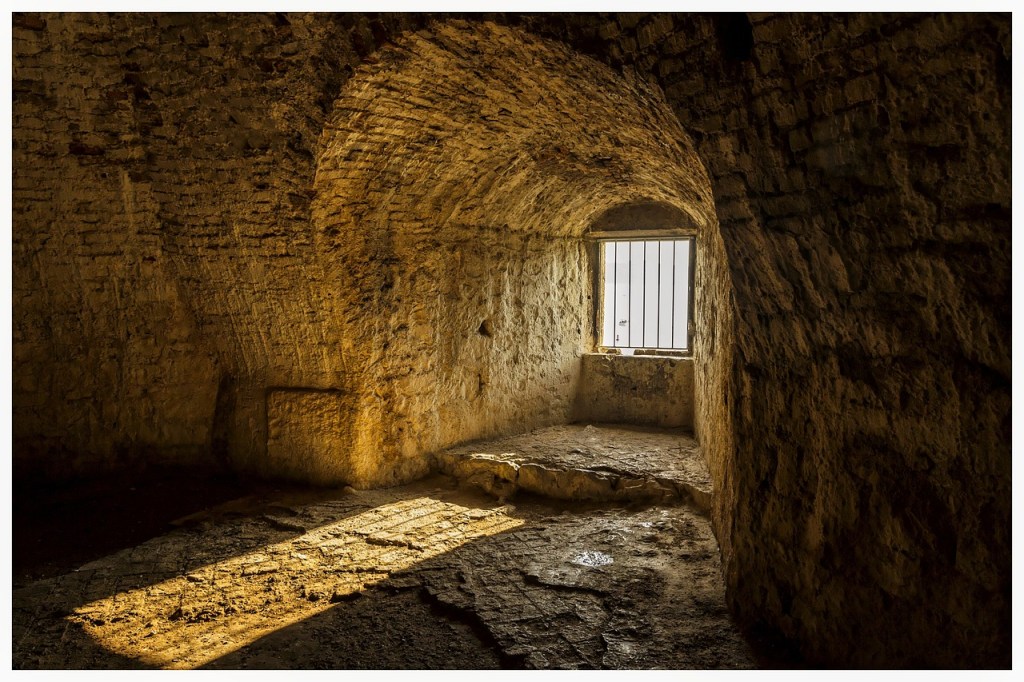
And when they had laid many stripes on them, they threw them into prison, commanding the jailer to keep them securely. Having received such a charge, he put them into the inner prison and fastened their feet in the stocks (Acts 16:23-24). Making sure that there was no chance of escape, Paul and Silas were put inside an inner prison, perhaps a dungeon underground, and feet placed in the stocks so they couldn’t escape of their own methods.
The Jailer would understand the importance of this and considered them a dangerous threat to Roman Law. He made sure that the city was secured from them.
Then two unusual events happened. First, we read, But at midnight Paul and Silas were praying and singing hymns to God, and the prisoners were listening to them. (Acts 16:25) This is unusual as a beaten prisoner would, most likely, fall into a state of despair. They might even question the existence of God and wondered why such a tragedy would befall them. However, Paul and Silas were true men of faith and prayed and sang.
As the apostle Peter later wrote, Yet if anyone suffers as a Christian, let him not be ashamed, but let him glorify God in this matter. (1 Peter 4:16). Paul would confirm this in his letter to the Philippians, Not that I speak in regard to need, for I have learned in whatever state I am, to be content: I know how to be abased, and I know how to abound. Everywhere and in all things I have learned both to be full and to be hungry, both to abound and to suffer need. (Philippians 4:11-12)
Notice, also, that it says the prisoners were listening to them. They, most likely, marveled at these two who were severely beaten yet found reason to rejoice.
The second unusual event went like this, Suddenly there was a great earthquake, so that the foundations of the prison were shaken; and immediately all the doors were opened and everyone’s chains were loosed. And the keeper of the prison, awaking from sleep and seeing the prison doors open, supposing the prisoners had fled, drew his sword and was about to kill himself. (Acts 16:26-27)
Asleep on the job is one of the highest violations that a guard, of any kind, can commit. Seeing all of the doors opened, the jailer assumed that all the prisoners had escaped. Knowing the penalty of this was public execution, he chose, rather, to end his own life and be done with it.
No Time Like the Present
However, before the jailer could carry out his suicide, he was immediately stopped. But Paul called with a loud voice, saying, “Do yourself no harm, for we are all here.” (Acts 16:28) The scriptures do not say whether Paul could see the jailer or simply hear him remove the sword from his sheath, but he knew what was about to transpire and put a stop to it.
None of the other prisoners said a word and, perhaps, they were hoping that the jailer would off himself so that he might escape. This is speculation of course.
Then he called for a light, ran in, and fell down trembling before Paul and Silas. And he brought them out and said, “Sirs, what must I do to be saved?” (Acts 16:29-30)
Knowing that a miraculous event had taken place, the jailer must have known that Paul and Silas were more than just “religious fanatics”. He had to have heard their prayers and songs. He knew that these two were different; especially from the other types of prisoners, he asked for salvation.
So they said, “Believe on the Lord Jesus Christ, and you will be saved, you and your household.” Then they spoke the word of the Lord to him and to all who were in his house. And he took them the same hour of the night and washed their stripes. And immediately he and all his family were baptized. (Acts 16:31-33)
Going back to verse 25, this all happened at midnight! Paul did not say, “We’ll make you a deal; get us freed in the morning, and we’ll save your soul then.” No, it was an immediate response! They preached to him, and his household, and they were immediately baptized. He and his family were not put on a schedule, they did not wait until the next worship service to be baptized, they did it right there and then.
Salvation is a soul-saving event and should never be put off for a “more convenient time” (Acts 24:25). It needs to be done right away. When I, myself, was baptized, it was done before the worship service began. The preacher didn’t want me to wait until after; squirming in my seat in anticipation or to change my mind. Rather, it was done immediately as I had requested to be baptized.
Never Judge a Book by its Cover
The remainder of the chapter speaks of the magistrate sent word to let Paul and Silas go. But Paul wouldn’t hear of it, But Paul said to them, “They have beaten us openly, uncondemned Romans, and have thrown us into prison. And now do they put us out secretly? No indeed! Let them come themselves and get us out.” And the officers told these words to the magistrates, and they were afraid when they heard that they were Romans. (Acts 16:37-38)
As you recall, at the beginning of this article, Paul and Silas were arrested as being Jews who were stirring up trouble. They weren’t given the chance to also state that they were Roman citizens! Here is the full reveal on that matter and the magistrates were in a full state of panic.
No trial was held to find them innocent or guilty, which is a violation of Roman Law, they were publicly beaten and cast into prison and now want them to be secretly released. Paul wanted his release to also be public since they wrongfully cast them into prison in the first place.
They were released and the magistrates pleaded with them (vs. 39). No doubt they didn’t want Paul and Silas to create a ruckus concerning their unfair imprisonment and urged them to leave the city.
Conclusion
In the world we live in, we can’t be quick to judge an individual by their appearance. Jesus said, “Do not judge according to appearance, but judge with righteous judgment.” (John 7:24)
We, as Christians, must remember the urgency of the need for salvation. As Paul wrote, Knowing, therefore, the terror of the Lord, we persuade men; but we are well known to God, and I also trust are well known in your consciences. (2 Corinthians 5:11)
If you are not a Christian, the time to change is now! Don’t put off for tomorrow what can be done today (2 Cor. 6:2). If you need assistance, please comment below and I’ll do my best to help you get on the path of righteousness.
 The Christian Caravan
Leave a comment